10/3/25
The Birth of A Nation (1915). My view of it as a biracial person, what makes it still relevant today and why everyone should see it, not despite of its ugliness but because of it.
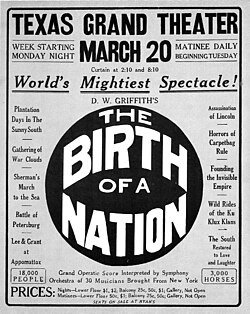
As a biracial person, I’ve always had this morbid fascination with what life was like for African-Americans in the early twentieth century. That morbid curiosity came to a head when I decided to watch, and review, The Birth of A Nation (1915), directed by D.W. Griffith, based on the novel and play The Clansman by Thomas Dixon Jr.
The film, credited with the revival of the Ku Klux Klan in America, is a 3 hour plus epic of romance, war and fear. The narrative, that the South lost an honorable fight and was driven into disarray by blacks and mulattos, is ripped straight out of the Lost Cause revisionism of the time. A chief architect of that view, Woodrow Wilson, is quoted in the film and would later have it be the very first film screened inside the Executive Mansion.
The first half is far more tame than the second. The story is told mainly through two families, the Northern Stonemans and the Southern Camerons. The film’s historical drama is juxtaposed with the romance of Elsie Stoneman and Ben Cameron, whose love is challenged by the Civil War and its aftermath. Abraham Lincoln is portrayed as a “good friend” to the defeated South while Austin Stoneman, a stand in for Republican Senator Thaddeus Stevens, is made out to be the true villain of the film. After Lincoln’s death the second half of the film begins. Stoneman forces his radical vision through Reconstruction by imposing a mulatto leader named Silas Lynch, who ensures Blacks can rig elections, marry white women, and beat up anyone who doesn’t agree.
The Klan’s formation is portrayed as a heroic response to Stoneman’s grip on the South through Reconstruction. Elsie breaks up with Ben when she finds out of his associations with the newly formed crusader group. The cliff jumping suicide of Ben’s sister, Flora Cameron, to escape from a black man who wanted to marry her, considered to be among the films most controversial plot points, spurs retaliation by the Klan. The man is murdered, the Klan rides in to oust the mulatto leader from his position in the town and Elsie’s romance with Ben is begun anew as he saves her and the town from “black rule”. The film ends with the Klan imposing “fair elections” by suppressing black participation.
The film was heralded as a masterpiece for its time and, for the technical aspects of filmmaking, it was. No film had so many thousands of extras as the Klan riding scene had in this film. Storytelling techniques we take for granted, such as close-ups, fade-outs, and crosscutting, were pioneered in this movie. It would be the highest grossing American film of all time until Gone With the Wind in 1939.
The film would inspire the second wave of the Ku Klux Klan and remained for decades, and perhaps even to this day, as a recruitment tool. The backlash to this film was also strong. The NAACP, along with black activists and leaders, such as W.E.B. DuBois and Booker T. Washington, slammed the film. Attempts to ban the film failed in Boston but were successful in Chicago, Minneapolis, Denver, and St. Louis. However, lynchings would rise substantially in the month after its release. One man was so moved by the assault on Flora Cameron in the film that he shot the movie itself, thinking he could save her.
The film’s reception prompted Griffith to name his next movie Intolerance, as a response to the intolerance he claimed his film endured upon release. Lillian Gish’s legendary 75-year long film career is still stained, some say unfairly, to this day by her role as Elsie Stoneman while Roaul Walsh, long before his directing days, plays John Wilkes Booth. Many, many actors are in blackface in the film but some scenes do have actual black actors in them, such as Madame Sul-Te-Wan.
Given the film’s notoriety and controversy, I won’t be rating this film at all. I won’t be giving it any 🦊 out of 5. Instead, I will give this stunning, harsh and cryptic warning:
This film, contrary to popular assertion, is NOT an ancient, racist relic of a bygone era. It is an immortal blueprint to the race-mongering, fear-striking propaganda we see today and have seen in the 110 years since. Claiming this film has no modern influence is preposterous. How could this film be irrelevant given the world we live in today? It is the prototype for all who use race and the fear of the other for political gain, from Joseph Goebbels to Nick Fuentes. It is the prototype for all the stories we see in the media warning us of the “dangerous Latinos” stealing our jobs, the “deranged blacks” cutting girls on the subway, and the assertion that white nationhood is a valiant cause being under constant assault.
Think about how one three-hour film promoted falsehoods in 1915 over what blacks were doing or had done to white America. Today, we see a new Birth of A Nation five nights a week on cable television. We see it in the far right echo chambers on social media. The Birth of A Nation is a blueprint for the present and a blueprint for the future country we may find ourselves in one day, if we’re not already there. I encourage everyone to watch this film, not just to ensure that the past is unforgotten but to also be warned of what is very much still a living dream. This film is groundbreaking, innovative, and foreshadowing for all the wrong reasons.
7/28/25
Eddington (2025)
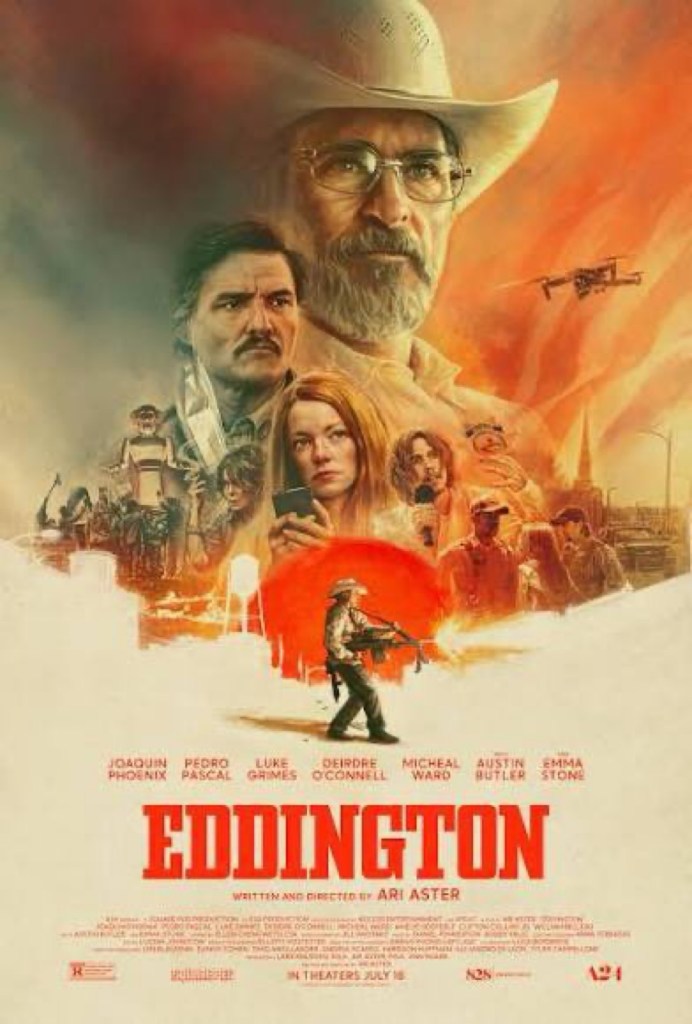
Alright, the moral of the story is New Mexico SUCKS!!! And I would know, I lived there for 13 years.
Anyways, the film is all over the place, it can’t stay in one lane. Just when you think you’re watching one movie, it suddenly shifts and turns into another one. This movie feels like “2020: The Movie”, where all sorts of different things from 2020 are thrown right in like a potpourri. It’s not too bad but it’s too much too.
I’m gonna give it:
🦊 🦊 🦊 1/2 out of 5
And a 🐦🔥 🍆 (iykyk 😏)
 Foxboy Media